DUCK PLAGUE
Duck Plague
Duck plague or duck viral enteritis is one of the most important viral disease affecting the domestic and wild ducks causing significant economic losses due to high mortality in duckling, morbidity and decreased in egg production.
How to Diagnose
1. Affected duck shows loss of appetite, decrease egg production, nasal discharge.
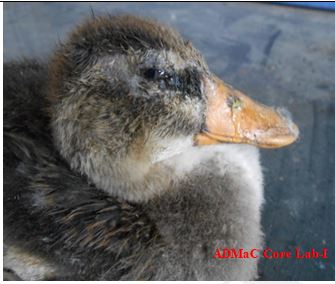
2. Affected ducks show watery, greenish diarrhoea, soiling of vent, increase thirst, unable to stand, tremors and a drooped-wing appearance, lameness, reluctant to move.
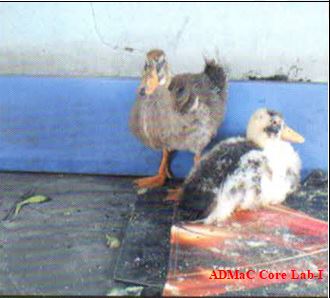
3. Pasting of feathers with secretion giving a circular zone surrounding to the eye.
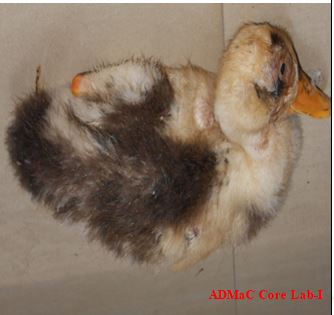
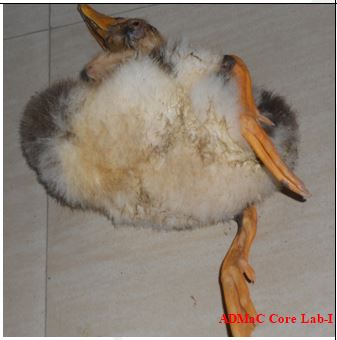
4. Duckling shows paddling movement of legs.
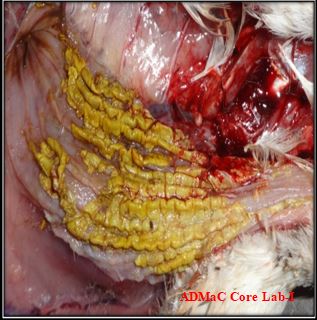
5. Creamy to yellow deposit in the food pipe.
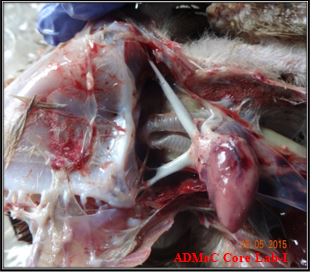
6. Blood spots on heart.
Type Samples to be collected:
From ailing ducks-serum and blood. In dead ducks- tissue samples like heart, spleen, liver, kidney, intestine
Laboratory tests to be performed :
a). Seological test- CIE, ELISA, FAT.
b). Virus isolation.
c). PCR.
Whom To Contact:
1). Local Veterinarian Officer/ Field Assistant.
2). NERDDL, AH & Vety Khanapara,
ADMaC Core Lab, AAU,
a). Dr. N.N. Barman,
E mail - nnbarman@gmail.com,
Mob No. 09435558788
b). Dr. Abhijit Deka,
Email : docabhijit93@gmail.com,
Mob no: 09864531247
What will you do:
1. Burry dead ducks in 5 to 6 feet deep pit putting sufficient amount of lime, washing soda, bleaching powder.
2. Confine healthy and affected ducks separately.
3. Don't allow to go to pond, any water body
4. Inform to the nearest Veterinary Officer/Field Assistant.
5. Send appropriate samples through Veterinary Doctor/Field Assistant to the nearest diagnostic laboratory/ ADMaC Core Lab-I, Khanapara for confirmation of the disease.
6. Affected ducks can be treated with antibiotics and vitamin in consultation with local Veterinarian.
7. Keep farm surrounding clean.
8. Vaccinate regularly.
Vaccine is available at
a). Institute of Veterinary Biologicals- Animal Husbandry and Veterinary Department, Khanapara.
b). College of Veterinary Science, Khanapara, Guwahati
Copyright © Designed & Developed by ICAR-NIVEDI 2023